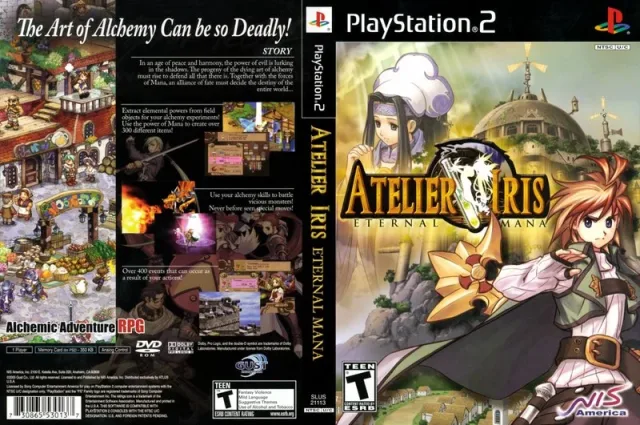
 1.4GB
1.4GB Atelier Iris - Eternal Mana
RPG 2005

Most role-playing games of the era let you survive a bad decision. Here, hitting an enemy's weakness earns you a half-turn, and being blocked or absorbed eats two of them, which means an entire party wipe can unfold in the time it takes to mis-target one spell. That arithmetic is the Press Turn system, and it is the reason a mid-game encounter with the demon Matador became shorthand for a certain kind of wall — the point where players either learned to build a party around resistances and Void skills or stopped playing.
The setup is bleaker than anything Atlus had put on a mainstream console before. Tokyo is destroyed in an event called the Conception and reborn as the Vortex World, a hollow sphere with a black sun at its centre. A Japanese schoolboy survives by having a parasitic insect forced into his eye, becoming the horned Demi-fiend, and from there the game barely speaks. Cutscenes are sparse, dialogue is clipped, and the surviving humans are less interested in rescue than in dictating the philosophical law the next universe will be built on. You choose one, or refuse them all.
Recruitment runs through conversation. Demons are talked into joining rather than caught, and they argue, extort money, lie and walk away mid-negotiation depending on the moon phase and their alignment. Fusion then grinds them into stronger stock, with skill inheritance that rewards planning several generations ahead. The Demi-fiend himself grows through Magatama, worn parasites that dictate which stats rise and which elements he absorbs or dies to, so even the protagonist is a build rather than a fixed hero.
What has aged is the presentation around all this. Dungeons are long, flatly lit corridor mazes, the Amala Labyrinth in particular tests patience more than skill, and the cel-shaded character models look thin next to the demon art they share the screen with. The soundtrack and Kazuma Kaneko's designs carry a lot of the weight.
It is a hard, unfriendly, deeply coherent game, and the modern Persona audience owes most of its combat vocabulary to it. Few RPGs have ever made an empty world feel this deliberate.
1.4GB  6.9GB
6.9GB  2.0GB
2.0GB  0.9GB
0.9GB  3.5GB
3.5GB  3.4GB
3.4GB  3.4GB
3.4GB  0.7GB
0.7GB loading comments…