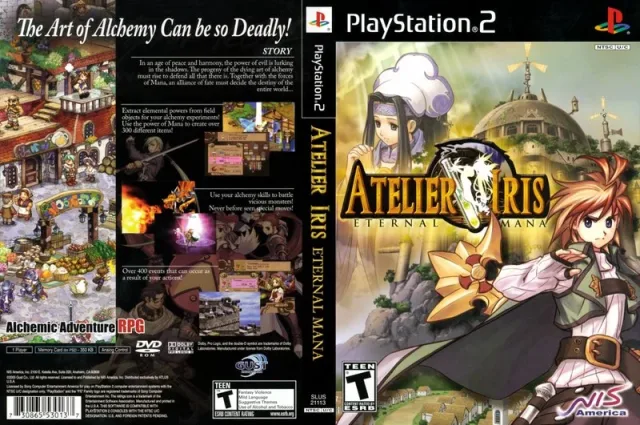
 1.4GB
1.4GB Atelier Iris - Eternal Mana
RPG 2005

A cat does the talking. Gouto, ancient and unimpressed, trails a fourteen-year-old in a school cap through a fictionalised Taisho-era Tokyo where trolleys, tabloid journalism and the occult all share a street corner. That framing is the reason Atlus's second Raidou game still stands apart from everything else in the Megaten catalogue: it is a detective story first, and the demons are equipment.
The investigation loop is where the design actually lives. Raidou carries captured demons in tubes, and outside battle each one has a use — sniffing out a scent trail, reading a stranger's surface thoughts, hauling aside a blocked passage, spotting what a human eye misses. Cases open with a client at the Narumi Detective Agency and progress by pointing the right species at the right obstacle, which turns fusion into something more interesting than raw stat-chasing. You end up keeping a mediocre fighter because it is the only thing in your stable that can talk to a horse.
Combat is real-time and, compared to the first Raidou, considerably less awkward. Two demons fight alongside you instead of one, the camera no longer works against you, and Raidou's sword and revolver give the player something to do beyond issuing orders. It is still not a deep action system. Encounters resolve mostly on elemental matchups and on how well you have built your roster, which means the fights that matter are decided at the fusion table rather than in the arena. Enemy demons must be beaten into a talking mood and then negotiated with, in the series tradition, and the conversations remain funnier and more petty than they have any right to be.
What holds it together is tone. The mystery involves a mountain village, a curse, and a conspiracy that reaches into the ministries, and the writing plays it straight enough that the pulp elements land rather than curdle. Kaneko's character designs and the muted period art direction give the whole thing a hand-drawn, slightly grubby quality that a higher-resolution machine might have smoothed away.
It arrived in the West in 2009, when almost nobody was buying PS2 games, and it has spent the years since as the odd cousin nobody talks about at Persona reunions. The dungeon layouts repeat, the sidequests can feel like padding, and the action never quite matches the ideas around it. But there is no other role-playing game where you solve a murder by handing a demon a cigarette and asking it to eavesdrop.
1.4GB  6.9GB
6.9GB  2.0GB
2.0GB  0.9GB
0.9GB  3.5GB
3.5GB  3.4GB
3.4GB  3.4GB
3.4GB  0.7GB
0.7GB loading comments…