 1.4GB
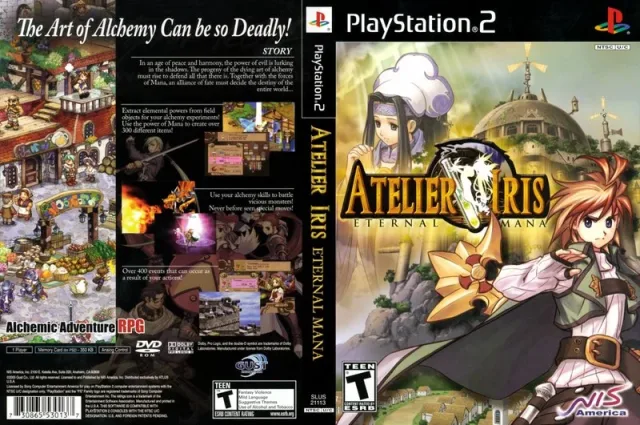
1.4GB Atelier Iris - Eternal Mana
RPG 2005

Al-Revis Academy is no longer the prestigious floating school it was. Enrollment has thinned, the faculty is coasting, and alchemy — the discipline the place was built to teach — is quietly failing across the world. That decline is the joke and the tragedy Gust builds its 2008 sequel around, and it gives the familiar term-by-term school structure an undertow the first Mana Khemia never had.
The game splits into two campaigns. Ulrika arrives from the countryside with a talking mana and a lot of enthusiasm; Raze is a stiff, put-upon boy dragged into the same classes from the other direction. You pick one, play a full year of assignments, exams and free periods, and see the other protagonist crossing your path from outside. Playing both is not a gimmick reshuffle — scenes read completely differently depending on which side of them you were standing.
Synthesis remains the spine. Almost nothing is bought and nothing is learned from a level-up screen: skills, stat bumps and passive traits all come out of the Grow Book, which unlocks nodes as you actually craft the items tied to them. Want a party member to hit harder or resist an element? Go make something. It means combat power is downstream of recipe hunting, and it means grinding fights for their own sake is close to pointless.
Battles use a front-and-back line where the reserve is not idle. Swapping a character in gives the outgoing fighter a support attack or a defensive intercept, and building the Unite gauge lets the whole formation pile on at once. The rhythm is quick, more about chaining supports on the right turn than out-statting anything. Backgrounds and character models were already dated on release; the sprite-and-portrait presentation and Gust's warm, jazz-inflected soundtrack carry it further than the polygons do.
It is a wordier, gentler game than its combat system suggests, and it ends up being one of the last things of real substance the PS2 got in the genre. A school story about institutional rot, told by students who mostly just want to pass their classes.
1.4GB  6.9GB
6.9GB  2.0GB
2.0GB  0.9GB
0.9GB  3.5GB
3.5GB  3.4GB
3.4GB  3.4GB
3.4GB  0.7GB
0.7GB loading comments…