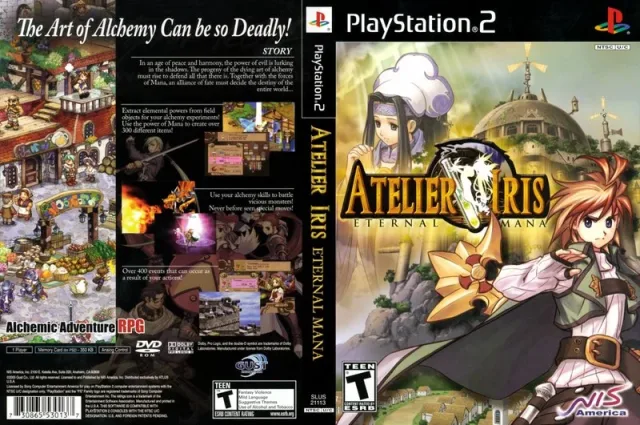
 1.4GB
1.4GB Atelier Iris - Eternal Mana
RPG 2005

The overworld map is gone. For nine games the series had let you shrink to a doll on a globe and wander between towns; here the pilgrimage road down Spira is a linear sequence of corridors, canyons and temple interiors, and Square built its 2001 PlayStation 2 debut around that decision rather than apologising for it. Every location is modelled at a fixed scale, characters have faces that move when they speak, and the trade-off is honest: you lose the freedom to roam and you gain a world that looks like somewhere people actually live.
The combat is the part that still teaches other games lessons. Conditional Turn-Based battle puts the upcoming turn order on the right side of the screen, so you can see that the Behemoth acts twice before Lulu gets a move, and you can see how a Haste or a slow, heavy attack shoves the whole queue around. Any party member can be swapped in at zero cost the moment their turn arrives, which quietly makes all seven of them mandatory rather than a starting three plus reserves. Enemies are designed against that: armoured foes for Auron, flyers for Wakka, fast ones for Tidus. It is a system that rewards knowing your roster instead of grinding a favourite.
Advancement runs on the Sphere Grid, a board of nodes unlocked with spheres dropped in battle. It looks freer than it is for most of a playthrough — each character starts on their own stretch of the board — but late on the walls come down and the grid becomes the endgame, the thing you feed hundreds of hours into if you go after the superbosses.
Spira itself is the reason the game outlived its hardware. A religion built on a lie, a summoner walking knowingly toward her own death, a support cast that argues about it. The voice acting is uneven and one laughing scene has been a joke for over twenty years, but the story commits to its ending in a way few blockbusters of the era did.
Blitzball, the underwater sport minigame, is either a tedious detour or the reason you stop advancing the plot for six hours. There is no middle position on it.
What holds up is the discipline: a game that gave up the map and spent everything it saved on the road ahead.
1.4GB  6.9GB
6.9GB  2.0GB
2.0GB  0.9GB
0.9GB  3.5GB
3.5GB  3.4GB
3.4GB  3.4GB
3.4GB  0.7GB
0.7GB loading comments…