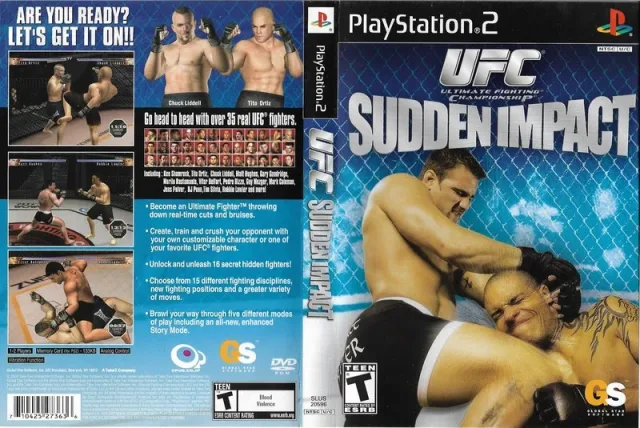
 1.3GB
1.3GB UFC - Ultimate Fighting Championship - Sudden Impact
Fighting 2001

The lock-on button is the whole argument. Hold it and the camera pins one thug out of the four circling you, and suddenly a street fight has the geometry of a one-on-one match: spacing, whiff punishment, throw attempts you can reverse if you read them. Let go and the crowd closes in again. Namco built its 2005 brawler around that toggle, and everything else in the game is downstream of it.
Brad Hawk is a hired troubleshooter working the gang war in Green Harbor, and the story is delivered in short, blunt cutscenes between roughly a hundred discrete missions. That structure is the second unusual choice. There are no scrolling stages, no long walks between fights. You get an arena, a set of objectives, sometimes an AI partner, and a specific problem to solve: beat three men with a pipe on the floor, survive a boss with reach on you, protect somebody who cannot protect himself. Missions last a couple of minutes. Fail one and you restart it immediately, which turns the campaign into something closer to a puzzle sequence than a beat 'em up.
Combat has more depth than the presentation suggests. Grapples chain into throws and into environmental slams, weapons break, counters exist for most attack types, and enemies gang up with real intent rather than politely queueing. The connection to Tekken is not just cosmetic — Paul Phoenix and Marshall Law turn up as unlockable fighters, and the animation weight comes from the same house. Against a single opponent the game is genuinely sharp. Against four, it can collapse into a scramble where you eat a hit from off-camera while committed to an animation you cannot cancel.
That is the flaw people remember. The camera and the crowd do not always cooperate, difficulty spikes arrive without warning, and a few missions ask for precision the control scheme cannot reliably give. The free-for-all versus mode, up to four players in a single arena with weapons scattered around, was the part that kept it in rotation; it is chaotic in the way the campaign only accidentally is.
It arrived late in the PS2's life, sold quietly, and never got a sequel. Twenty years on it reads as a real attempt to build a fighting game engine that works with more than two people on screen — an idea very few developers have bothered to try since, and one that deserved a second draft it never received.
1.3GB  1.1GB
1.1GB  0.9GB
0.9GB  1.6GB
1.6GB  3.0GB
3.0GB  1.6GB
1.6GB  0.5GB
0.5GB  0.5GB
0.5GB loading comments…