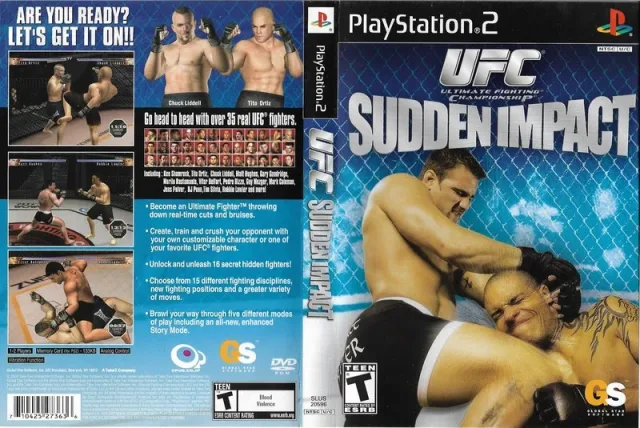
 1.3GB
1.3GB UFC - Ultimate Fighting Championship - Sudden Impact
Fighting 2001

Tekken 4 had walls, slopes and uneven ground, and it spent most of its life apologising for them. The fix here is almost aggressively conservative. Arenas go flat again, infinite in most cases, walls used as a deliberate design choice rather than a constant. Recovery from knockdown is quicker, movement tightens, and the whole thing snaps back to the rhythm players had spent years learning in Tekken 3 and Tag Tournament. It is the rare sequel that improves by admitting the previous one guessed wrong.
What that restored engine supports is a roster of more than thirty fighters, with Asuka Kazama, Feng Wei and Raven joining as genuinely distinct additions rather than clone slots. Asuka's counters and Feng's Chinese martial arts give the newcomers real identity; Raven's teleporting mixups still show up in tournament play discussions decades later. Jinpachi Mishima closes the arcade ladder, and his unblockable fireball remains one of the more resented boss designs in the series, an old-fashioned coin-eater bolted onto an otherwise fair game.
The customisation system is the other lasting addition. Arcade fight money buys hats, jackets, glasses and hair for every character, and while it is cosmetic, it changed how people related to their mains. A Hwoarang in a bear head is a small thing, but it turned a fixed cast into something players felt some ownership over, and the idea never left the series.
Namco treated the PS2 release as a home package rather than a port. Devil Within casts Jin in a full third-person beat-em-up with platforming and light exploration, an odd, sometimes clumsy detour that nonetheless has more effort in it than most fighting-game story modes of the era. Arcade History carries emulated versions of the first three arcade Tekken games, warts and low polygon counts intact, and StarBlade is playable while the disc loads. That kind of generosity was standard practice for Namco then and has largely vanished since.
What holds up is the fighting. The sixth generation was where 3D fighters finally stopped feeling like experiments, and this is the clearest statement of that: readable animation, deep sidestepping, punishment windows you can actually learn. Dark Resurrection would refine it further, but the version that reassured everyone the series knew what it was doing is this one. Put two people in front of it now and nobody spends time wishing the floor were more interesting.
1.3GB  1.1GB
1.1GB  0.9GB
0.9GB  1.6GB
1.6GB  3.0GB
3.0GB  1.6GB
1.6GB  0.5GB
0.5GB  0.5GB
0.5GB loading comments…