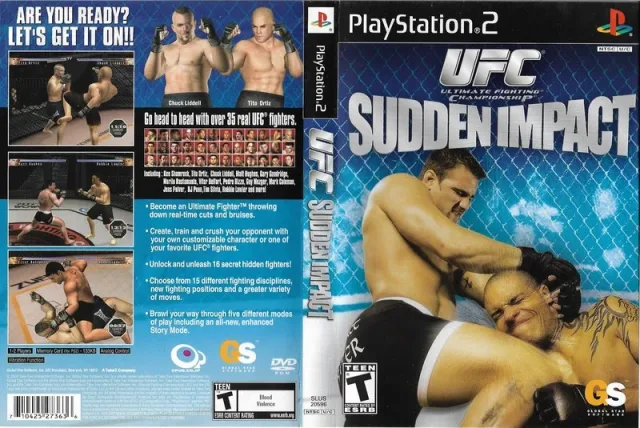
 1.3GB
1.3GB UFC - Ultimate Fighting Championship - Sudden Impact
Fighting 2001

Walls. That was the gamble. After three entries fought on featureless flat planes, Namco built stages with fences, alleyways, slabs of raised concrete and gently sloping ground, then asked a fighting engine tuned over six years to cope with all of it. Corner someone in the airport hangar and the round changes character completely. Juggle them off a ledge and the camera lurches to follow. It was the boldest structural change the series ever attempted, and the arguments about whether it worked have outlived most of the games it competed with.
The movement rework underneath it is easy to miss and matters more. Sidestepping became a proper positional tool rather than a dodge, and the whole cast gained a repositioning shuffle that made spacing feel closer to boxing footwork than to the crisp lane-switching of Tekken 3. Combined with the terrain, it produced matches that were slower, grabbier, more about cornering an opponent than out-comboing them. Competitive players largely hated it. Jin's parry, in particular, warped high-level play badly enough that it became shorthand for the game's balance problems.
Story mode was where the ambition showed most warmly. Every character got pre-rendered chapter breaks and a real narrative thread, hung on the King of Iron Fist Tournament being called to lure Kazuya back into Heihachi's orbit. Steve Fox arrived here, a British boxer with no kicks at all, which sounds like a joke until you fight him. Craig Marduk and Christie Monteiro turned up too, and Jin returned with his Mishima moveset stripped out and replaced by traditional karate, a change that annoyed as many people as the walls did. Tekken Force came back as a scrappy beat 'em up diversion, still more novelty than mode.
What holds up now is the presentation. The character models were among the best on the console in 2002, the stages have a lived-in grubbiness the series later traded for spectacle, and the soundtrack leans harder into drum and bass than anything before or after it. What does not hold up is the balance, and Tekken 5 corrected almost all of it within two years, keeping the walls and throwing out most of the rest.
It sits in the series as the interesting failure, the one that took a real risk and paid for it. Play it as a curiosity rather than a fighter to master, and the roughness reads less like a flaw than like a studio thinking out loud.
1.3GB  1.1GB
1.1GB  0.9GB
0.9GB  1.6GB
1.6GB  3.0GB
3.0GB  1.6GB
1.6GB  0.5GB
0.5GB  0.5GB
0.5GB loading comments…