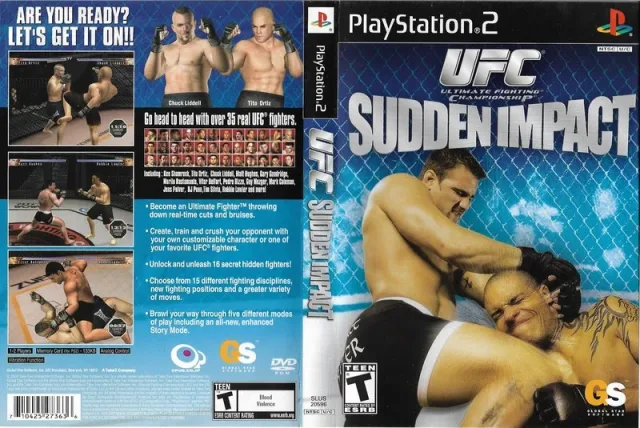
 1.3GB
1.3GB UFC - Ultimate Fighting Championship - Sudden Impact
Fighting 2001

One hundred and sixty-one selectable fighters. That number was the whole pitch in 2007, and it says a lot about what Spike thought this series was for: not a tightly balanced competitive fighter but an encyclopedia you could throw punches inside. Goku alone spans a childhood version, half a dozen Super Saiyan tiers and a couple of fusions, and the deep cuts run out to movie villains and GT stragglers most players had to look up.
The combat is behind-the-back arena fighting, not 2D plane work. You lock onto an opponent, dash, teleport out of a combo with Z Burst Dash, and spend a shared ki pool on beams while managing a small stock of blast cards for buffs and counters. Beam clashes turn into button-mashing tug-of-war. It is loose, generous, and enormously satisfying when a chase across an open sky ends with a Kamehameha punching your opponent through a rock face, which the destructible stages will happily register. It is also shallow if you look for depth it never promised. Guard-break and dash pressure dominate, and the AI on higher difficulties leans on reads rather than skill.
The third entry added two things worth remembering. Day and night cycles gave certain characters conditional power, most obviously the Great Ape transformations that only trigger under a full moon, tying an anime rule directly into a mechanic. And there was online play, a rarity on PS2 by that point, propped up by servers that are long gone but which briefly made the roster feel like a collectible deck rather than a museum. Disc Fusion, which read a Budokai Tenkaichi 2 disc to unlock extra content, was the sort of gimmick only a series this comfortable in its own skin would attempt.
Dragon History replays the saga from the Saiyan arc onward in condensed bursts, with objectives that reward mimicking the source material. It is not storytelling so much as annotation, and it works because the game trusts you to already know the plot.
As a fighting game it has been comprehensively outclassed. As the largest and last of its line on the hardware, it remains the version fans keep going back to, arguing about tier lists for a game that never wanted one.
1.3GB  1.1GB
1.1GB  0.9GB
0.9GB 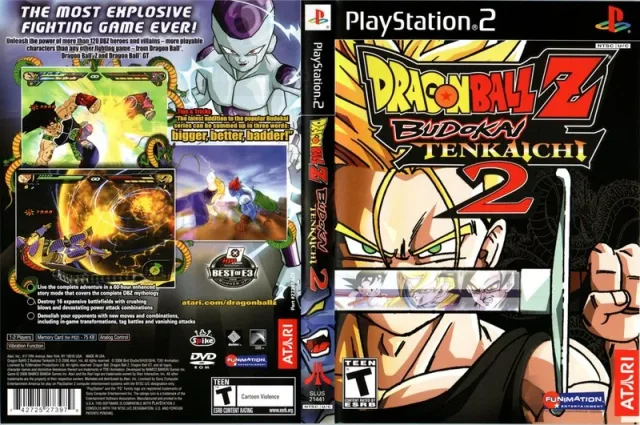 1.6GB
1.6GB  3.0GB
3.0GB  1.6GB
1.6GB 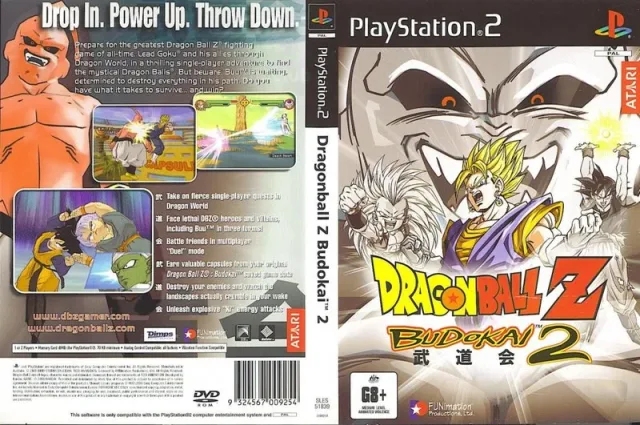 0.5GB
0.5GB  0.5GB
0.5GB loading comments…