 4.1GB
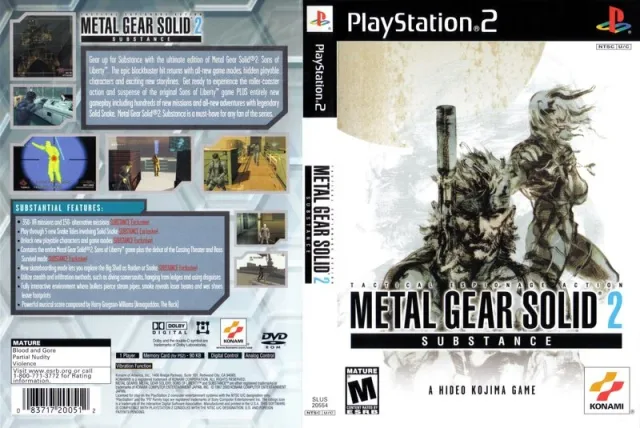
4.1GB Metal Gear Solid 2 - Substance
Stealth 2002

Two players creep in third person, weaponless except for gadgets and a pair of hands. Two more stomp around in first person with assault rifles and a headset full of static. Spies versus Mercs was the reason this sequel got talked about in 2004, and it remains one of the few genuinely asymmetric multiplayer designs of the sixth generation: two entirely different control schemes, two different camera perspectives, one shared map. The spies could climb pipes and hang from railings; the mercs could barely look up. That imbalance was the point, and learning to exploit it produced a tension no deathmatch could reach.
The single-player campaign, built by Ubisoft Shanghai, is more conventional business. An American embassy in Dili falls, an Indonesian militia leader named Sadono seeds smallpox across the United States, and Sam Fisher goes wall-to-wall through Jerusalem, a moving Paris train, a Los Angeles television studio. The light-and-shadow meter and the noise gauge still govern everything, and Michael Ironside still growls the exposition. What is new is small but useful: the half-split jump, which wedges Fisher above a doorway to drop on whoever walks under, and the SC-20K's diversion camera with its whistle and gas.
The design is also stricter than its reputation suggests. Alarms are capped on many missions, so a third detection ends the level rather than escalating it, which pushes you toward reloading a checkpoint instead of improvising an escape. Guards spot you at distances that feel arbitrary until you learn their exact cones. It is a game about memorising rooms, and it does not pretend otherwise.
The PlayStation 2 build is the compromised one. Xbox hardware handled the original engine's dynamic shadows more comfortably, and the port trims lighting detail, geometry and texture work to hold a frame rate. Levels are chopped into shorter chunks with more loading between them. Yet the essential loop survives, because it was always built on darkness, patience and a sound meter rather than raw fidelity.
Seen now, it is the middle chapter, tighter than the first game and less inventive than Chaos Theory. But that four-player standoff, spies clinging to a ceiling while a merc sweeps a torch across an empty floor, is still the sharpest thing the series ever did with other people.
4.1GB  2.0GB
2.0GB  2.8GB
2.8GB  3.2GB
3.2GB  1.8GB
1.8GB  3.2GB
3.2GB  2.2GB
2.2GB  2.5GB
2.5GB loading comments…