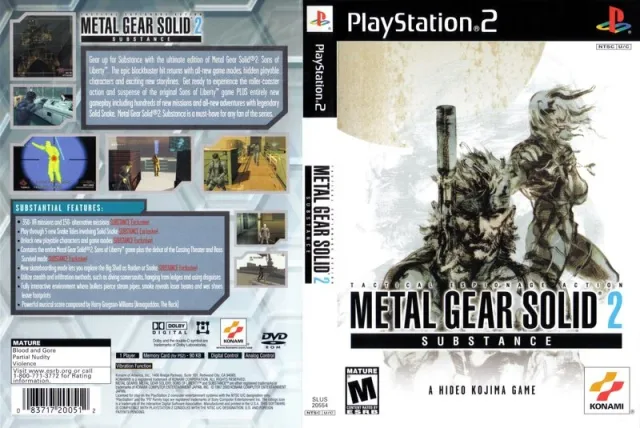
 4.1GB
4.1GB Metal Gear Solid 2 - Substance
Stealth 2002

The knife changed everything. Two games in, Sam Fisher had learned to hide bodies and shoot out lights, but he had no quiet way to end an encounter and no way to open a path that wasn't a door. Chaos Theory hands him a blade, and suddenly canvas tents can be cut through, a grabbed guard can be questioned with steel at his throat, and lethal force stops being a loud last resort. It sounds like a small addition. It rewrites the whole moment-to-moment calculus.
The other rewrite is the sound meter sitting under the light gauge. Noise had always been notionally tracked in the series, but here it is a visible budget measured against ambient volume, so a humming generator or a rainstorm becomes cover in the same way darkness does. Ubisoft Montreal built levels around that idea rather than bolting it on: the bathhouse, the Peruvian jungle, the lighthouse assault all give you loud spaces and dead-quiet ones and expect you to plan your route between them. Amon Tobin's score reacts to the same state machine, sliding from low hum to alarm without a jarring cut.
Missions grade you on percentage rather than pass/fail alarms, which is the change that made replay worthwhile. You can knock every guard cold, or ghost the level untouched, and the game respects both while quietly telling you which one it thinks was cleaner. Objectives split into primary, secondary and opportunity tiers, so a mission rarely collapses just because a plan went sideways. It is the most forgiving Splinter Cell up to that point, and also the most demanding if you want the numbers.
The PS2 version is the compromised one and worth being honest about. The Xbox release was a normal-mapping showpiece and the shadows there are sharper, the textures denser; here things are softer, the lighting less articulate, some geometry pared back. What survives intact is the design, which was never dependent on the hardware showing off. Co-op returns with its own two-agent campaign, and Spies versus Mercenaries remains one of the strangest and best asymmetric multiplayer ideas of the generation, third-person acrobats against a first-person gun.
Twenty years on it still reads as the point where the series stopped being a tense corridor puzzle and became a toolkit. Later entries traded patience for momentum. This one assumed you wanted to sit in the dark and think.
4.1GB  2.0GB
2.0GB  2.8GB
2.8GB  1.8GB
1.8GB  3.2GB
3.2GB  2.2GB
2.2GB  2.5GB
2.5GB  2.5GB
2.5GB loading comments…