 7.6GB
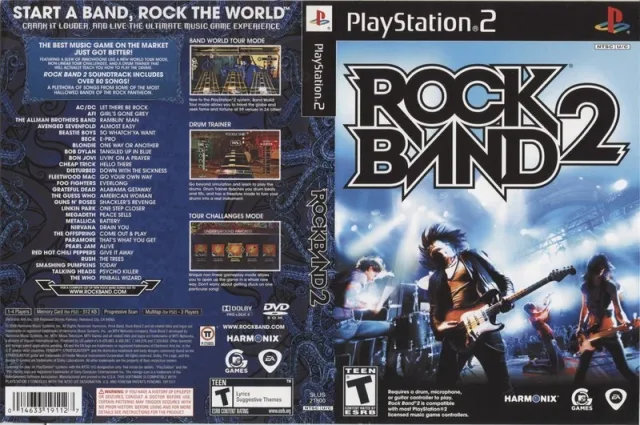
7.6GB Rock Band 2
Rhythm 2008

A villain who plans to turn every food on Earth into noodles is not the kind of premise most sequels get greenlit on, and the fact that Colonel Noodle exists at all tells you how little Masaya Matsuura's team cared about growing up between PlayStation generations. Six stages, a paper-thin dog in an orange beanie, and a mantra about believing. The PS2 hardware bought sharper edges and smoother animation for the same cardboard-cutout characters wandering around polygon sets, and almost nothing else changed.
The lessons still work the way they always did. A teacher raps a line, the button prompts scroll across the top of the screen, and you answer it back in time. Beard Burger Master returns to bark about flipping patties; a barber shop, a driving-school echo, and a romance detour follow. What separates this from the wave of rhythm games that arrived after it is the grading, which is not a note-accuracy meter. Hit the prompts exactly and you stay in the middle grade forever. To reach Cool you have to abandon the written line and improvise something that sounds like a rap phrase, at which point the teacher shuts up and lets you run the track solo.
That system is the best idea in the series and the reason people still argue about it. The game has opinions about rhythm it never explains, and a riff that feels great can be marked down while a simpler one sails through. Coming back to it now, the input timing feels loose in a way that later games in the genre trained us out of tolerating. You learn to trust the audio over the prompts.
The soundtrack is the other reason it holds. Matsuura writes actual songs rather than backing loops, and the vocal performances are odd, wordy and specific enough to lodge in memory for decades. It is short, it is easy to finish, and the two-player versus mode is a footnote rather than a draw.
What you take away is not a challenge conquered but a set of phrases you cannot stop repeating, which was probably the point all along.
7.6GB  1.9GB
1.9GB  1.6GB
1.6GB  3.1GB
3.1GB  4.8GB
4.8GB  0.7GB
0.7GB  1.4GB
1.4GB  4.2GB
4.2GB loading comments…