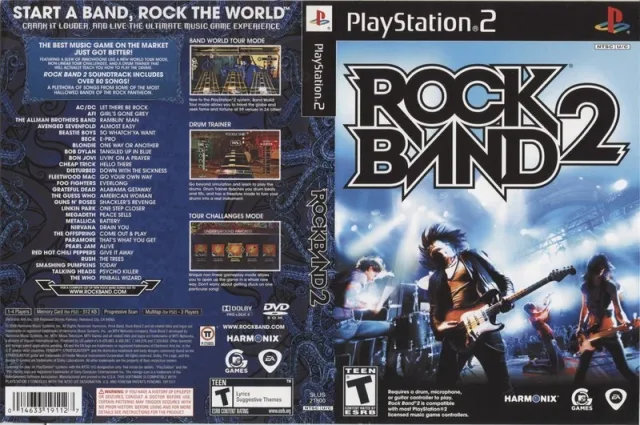
 7.6GB
7.6GB Rock Band 2
Rhythm 2008

Almost none of the music in it is the original recording. The 2005 setlist is dominated by note-for-note session covers, licensed compositions re-tracked by studio players, and at the time that felt like a compromise nobody could avoid. It stopped mattering roughly thirty seconds into "I Love Rock 'n Roll", because what Harmonix and RedOctane had actually built was not a jukebox but a lie detector for your hands.
The controller did the arguing. A three-quarter-size Gibson SG with five coloured fret buttons, a strum bar that had to be hit in time with the chart, a whammy for sustains and a tilt sensor for Star Power. Plenty of rhythm games before it asked you to press buttons in time. This one asked you to hold down a shape with your left hand while your right kept a separate rhythm, which is not guitar playing but is close enough to the coordination problem of guitar playing that the difficulty curve feels honest. Medium teaches you the fourth fret. Hard introduces the fifth and the pinky stretch that goes with it. Expert simply stops being polite.
Career mode is a run up through venues, from a basement dive to an arena, with cash spent on new axes, finishes and unlockable songs. It is thin scaffolding and it does not need to be more. The real progression is that the encore at each tier is a wall: "Cowboys From Hell", then "Bark at the Moon", the closing boss of a game with no bosses, a solo that has broken more plastic strum bars than any other chart in the series.
What has aged is the presentation. The venues are flat, the animation loops repeat, and the crowd is a texture rather than an audience — the later franchise entries and Rock Band both look considerably richer. What has not aged is the note charting, which remains among the most musical Harmonix ever produced, phrases written so that your fingers land where a guitarist's would. Two players can trade off in Face-Off, splitting a song section by section, and that alone kept the disc in trays for years.
The sequels got the master recordings, the bigger bands and the drum kits. None of them recaptured the specific shock of the first time a room full of people watched somebody clear an Expert solo on a toy.
7.6GB  1.9GB
1.9GB  1.6GB
1.6GB 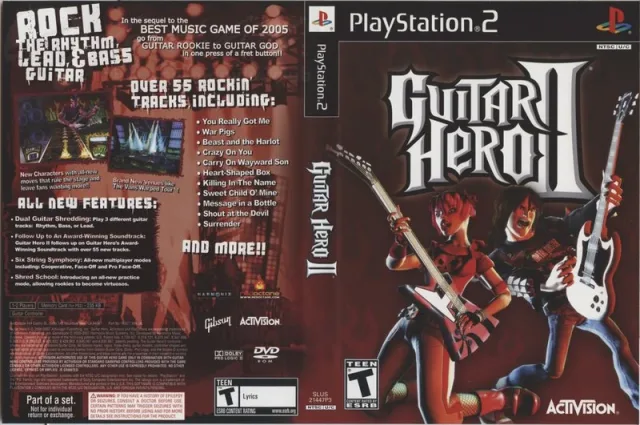 3.1GB
3.1GB  4.8GB
4.8GB  0.7GB
0.7GB  1.4GB
1.4GB  4.2GB
4.2GB loading comments…