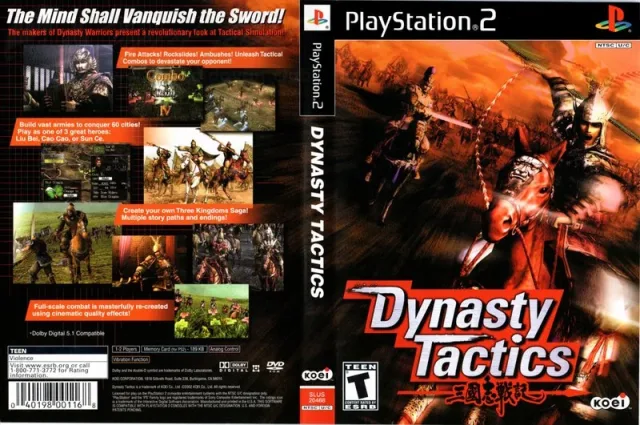
 2.9GB
2.9GB Dynasty Tactics
Strategy 2002

A castle drawn in cross-section, its floors stacked like shelves in a dollhouse, with elves trundling along corridors to tap glowing mana crystals while skeletons shuffle up a staircase toward them. That is the battlefield here, and it is the reason a real-time strategy game on the PlayStation 2 works at all. By flattening the fight onto a single vertical plane, Vanillaware removed the one thing that always sank console RTS design: the camera. You are never rotating anything or hunting for a unit off-screen. Everything is laid out in front of you like a stage set.
The setting is a magic academy, and the student is Lillet Blan, who arrives for her first week of lessons and watches everyone in the building die. Then she wakes up on the first day again. The five-day loop is not framing dressing; it is how the campaign teaches itself, since each repetition hands Lillet another of the four grimoires and the knowledge of what is coming. Glamour summons fairies and elves, Necromancy raises the dead, Sorcery bargains with demons, Alchemy builds constructs. Units divide into astral and substantial, and the wrong army against the wrong enemy simply cannot land a hit, which turns most missions into a reading problem before it becomes a fighting one.
Mechanically it is lean to the point of austerity. You place runes, runes produce familiars, familiars gather mana or fight, and the enemy does the same from the other side of the map. There is no base-building sprawl and no economy to speak of beyond crystal count. What the missions ask instead is precision: hold a corridor with the two units that counter what is coming through it, and get your production order right the first time, because a mana deficit at minute three is usually unrecoverable.
The art is the part people remember, and fairly. This is early Vanillaware, before Odin Sphere reached shelves, and the sprite work already has that painterly weight — banners, stonework, the fussy little animation cycles on the imps. It also exposes the game's limits. Maps are small, unit counts are modest, and a mission that goes wrong tends to go wrong in the same way twice. Anyone expecting the depth of a PC strategy game will find the ceiling quickly.
What survives is a strange, quiet, unusually elegant thing: a strategy game whose difficulty comes from knowledge rather than dexterity, told by a girl who already knows how the week ends. Failure is written into the plot, which makes losing feel less like punishment than rehearsal.
2.9GB  1.4GB
1.4GB  1.0GB
1.0GB  0.3GB
0.3GB  0.6GB
0.6GB  0.5GB
0.5GB  3.6GB
3.6GB  0.8GB
0.8GB loading comments…