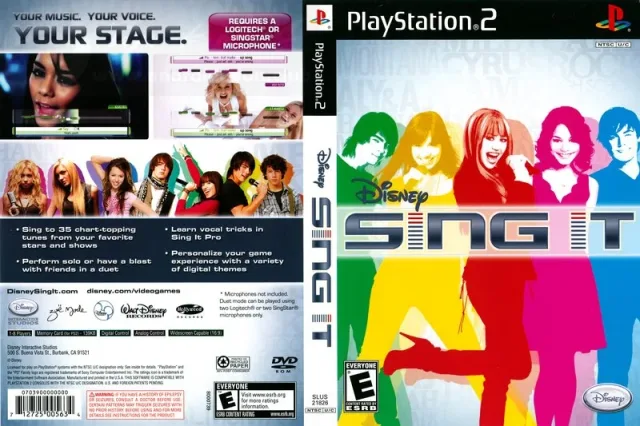
 1.9GB
1.9GB Disney Sing It - Pop Hits
Rhythm 2008

Six songs written for a 1967 animated feature turn out to be sturdier rhythm-game material than anyone had a right to expect. "I Wan'na Be Like You" swings hard, "Colonel Hathi's March" is built on a metronome of a beat, and "Trust in Me" slinks along at a tempo that makes late notes feel like a personal failure. Ubi Soft's take on the Disney licence leaned on that, handing Mowgli a dance routine instead of a platforming gauntlet and asking players to keep him on the beat.
The mechanics are the standard scrolling-prompt kind, refined into something legible for very young hands: symbols travel toward a marker, you hit the matching input, and a combo meter rewards you for not breaking stride. What separates it from the arcade-derived dance games it arrived alongside is the presentation. Every successful string of inputs pushes Mowgli through more elaborate choreography against sequences built from film assets, so the reward for accuracy is a performance rather than a number climbing on a scoreboard. Miss enough and the routine visibly falls apart, which is a far clearer signal to a child than a failing letter grade.
It also supported a dance mat, which was the whole reason the concept existed in 2000. That was the moment the mat was becoming a viable living-room peripheral outside Japan, and a Disney soundtrack was an obvious way to sell one to parents. Played on a pad the game holds up as a short, cheerful workout. Played on a controller it becomes something closer to a memory drill, and the shortness of the tracklist starts to show quickly.
That is the honest limitation. Six songs, however good, are six songs, and the difficulty ceiling is set low enough that an adult will exhaust the material in an afternoon. The two-player mode extends things a little, mostly through the comedy of watching someone else fail in front of you. Later rhythm titles on the same hardware offered dozens of tracks and far tighter timing windows, and by comparison this feels like a small, well-mannered thing rather than a competitive one.
What it does have is a specific charm that the genre mostly abandoned once it got serious about scoring systems. There is no attitude here, no unlockable difficulty spirals, just a boy dancing with a bear to music that was already half a century old when the disc shipped. As an introduction to rhythm games for someone too young for anything harsher, it remains close to ideal.
1.9GB  1.6GB
1.6GB  3.1GB
3.1GB  4.8GB
4.8GB  0.7GB
0.7GB  1.4GB
1.4GB  4.2GB
4.2GB  2.5GB
2.5GB loading comments…