 1.1GB
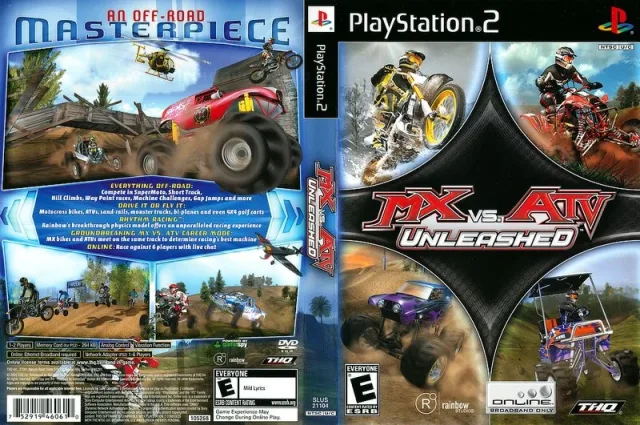
1.1GB MX vs. ATV Unleashed
Racing 2005

The moment that separates this from every other bike game of its generation comes when you switch the riding style to Professional and suddenly the rider stops being scenery. Your left stick steers and leans the machine; the right one hangs the rider off the seat, shifting weight into the corner or back over the tank under braking. Get it wrong and the bike stands up mid-apex and runs wide. Get it right and you feel the whole thing pivot underneath you.
Polyphony Digital built Tourist Trophy on the Gran Turismo 4 engine, and it shows everywhere from the menu fonts to the circuits, which are lifted straight from the car game — Suzuka, Laguna Seca, Tsukuba, the Nürburgring, plus the fictional city and mountain roads. That reuse was the only way a project this specialised could exist in 2006, and it works better than it should. The tracks were modelled for machines with four wheels and far less lean angle, yet riding them on a superbike reframes them completely; a corner you knew cold in GT4 becomes a question of how much you dare hang off.
The garage is the other half. Roughly a hundred and thirty bikes from Honda, Yamaha, Ducati and others, covering scooters, naked bikes, classic two-strokes and modern litre machines, all bought with credits earned from a licence-and-event structure identical to Gran Turismo's. Parts fitting is shallower than the car game — no engine swaps, mostly tyres, suspension, exhausts and gearing — but weight distribution and tyre choice matter enormously on two wheels, so the tuning screen still earns its place.
What has aged is the handling of failure. There is no crash damage and no real consequence: the rider is flung off, the game fades, and you are set back on the tarmac moving again. It keeps the pace up and avoids the grim business of animating a high-side properly, but it also drains the tension out of the fastest bikes, which should feel like they might kill you. The AI, inherited from GT4, is similarly polite, holding its line while you barge past.
It sold modestly and never got a sequel, which is a shame, because nothing since has treated motorcycle racing with quite this much patience. Photo Mode is here too, and it is not a throwaway — Polyphony clearly wanted you to stop and look at the machines. Two decades on, the most convincing thing about it is still the small stuff: the way a bike settles under trail braking, the wobble as you pick it up out of a slow corner. Learning that is the whole game, and it does not hand it to you.
1.1GB  1.4GB
1.4GB  1.8GB
1.8GB  0.1GB
0.1GB  2.0GB
2.0GB  0.1GB
0.1GB  0.3GB
0.3GB  1.0GB
1.0GB loading comments…