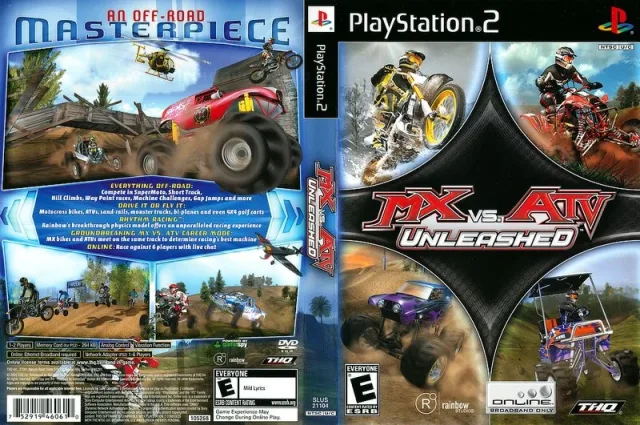
 1.1GB
1.1GB MX vs. ATV Unleashed
Racing 2005

Rain never stops falling on the city, and that turns out to be the whole visual argument. Every surface throws back neon, headlights smear across the asphalt, and the road ahead dissolves into bloom the moment nitrous kicks in. EA Black Box understood that a Honda Civic doing 110 could be made to feel faster than a Lamborghini doing 190, provided you blurred the edges of the screen hard enough. It worked. The 2003 reinvention of Need for Speed dumped the police chases and the supercar catalogue that had defined the series and replaced them with import tuner culture at the exact moment that culture was at its commercial peak.
Underground Mode is a long chain of events rather than a city you drive around, and that structure is more honest than the series later gave it credit for. You pick a race off a menu, win it, unlock parts and cars, and grind upward through more than a hundred events. Circuit and sprint races are conventional. Drift scoring on tight closed courses rewards holding an angle rather than a line, and drag racing strips the car down to shifting at the redline and flicking between lanes while traffic closes in — one mistimed lane change and the run is over in a second. Knockout events cut the last-place driver each lap, which sharpens the aggression considerably.
Customisation is the part that reshaped the genre. Body kits, spoilers, rims, vinyl layers, underglow, hood scoops, window tint — and crucially, visual work fed into a reputation system, so making the car uglier or gaudier still counted as progress. Performance upgrades were tied to race wins, so the tuning was less about engineering than about earning the right to bolt something on. Whether the results looked good was, mercifully, left to you.
What has aged is the difficulty curve and the rubber-banding. Rival cars hang on your bumper regardless of your build, and the last third of the career leans on that hard, which turns some races into memory tests of where the walls are. The handling is pure arcade: no weight to speak of, tap-and-hold cornering, walls that scrub speed instead of ending runs. The soundtrack, all crunching nu-metal and crunk, dates the thing to within about eighteen months.
Underground 2 gave the formula an open world and better presentation, but this first pass is tighter and meaner, with less time spent driving to the next thing. Two decades on, the reflections in the wet road still do more work than the polygon count ever could.
1.1GB  1.4GB
1.4GB  1.8GB
1.8GB  0.1GB
0.1GB  2.0GB
2.0GB  0.1GB
0.1GB  0.3GB
0.3GB  1.0GB
1.0GB loading comments…