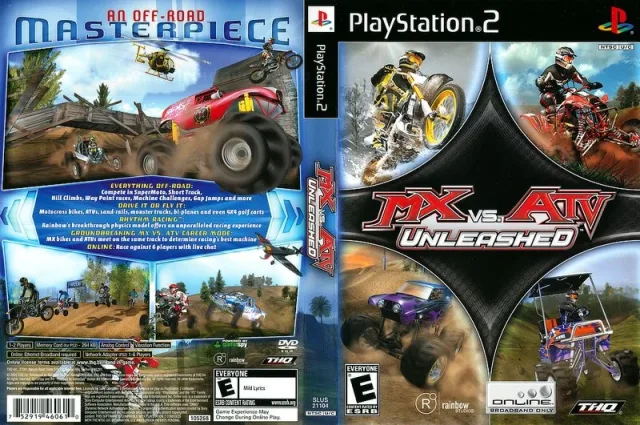
 1.1GB
1.1GB MX vs. ATV Unleashed
Racing 2005

The single rule change is the whole game. In Burnout 3, clipping a saloon at 180mph ended your run in a shower of parts. A year later, Criterion decided that any vehicle travelling in your direction was no longer an obstacle but a projectile, and the physics of an entire series shifted. You barge a hatchback into the oncoming lane and watch it scatter a rival. Only buses, trucks and head-on traffic still punish you.
That one decision makes the racing meaner rather than easier. Because checking is rewarded, the roads become dense and busy on purpose, and the ideal line runs straight through the middle of the pack instead of around it. Boost still comes from risk — near misses, oncoming lanes, drifts — and the boost bar still chains without interruption once you have earned the right to it, so a clean lap is a continuous roar of speed with occasional violence punctuating it. Takedowns now count vertically as well, and dropping onto a rival from a raised section is a genuinely satisfying piece of aggression.
Crash mode got rebuilt too, and this is where opinion splits. Junctions are scored with multipliers and a Crashbreaker that lets you detonate the wreck and shove the debris further into traffic, which turns each intersection into a small puzzle about where to put the explosion. Some players preferred the purer geometry of the older version. The Crashbreaker also appears in races, letting you blow up your own car after a wipeout to take somebody else out on the way down, which is either the series at its most gleeful or its most silly depending on your mood.
The PS2 version runs at 30 frames per second where the Xbox 360 release later hit 60, and you feel it — the motion blur and the screen-shredding sense of velocity are doing a lot of work to cover a frame rate that struggles when six cars pile into a barrier. It still holds up remarkably well. Traffic streams in convincingly, the crash cameras have real weight, and the licensed soundtrack with its DJ chatter dates the mid-2000s as precisely as any tie-in could.
Revenge is the loudest Burnout, the one least interested in restraint, and the traffic-checking rule that made it so is also the reason purists still argue for its predecessor. Both positions are defensible. What is not in doubt is that no other racer of the generation made destruction feel this much like a driving skill.
1.1GB  1.4GB
1.4GB 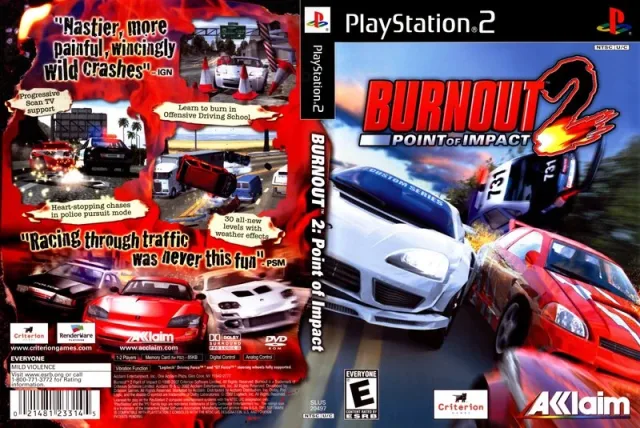 1.8GB
1.8GB  0.1GB
0.1GB  2.0GB
2.0GB  0.1GB
0.1GB  0.3GB
0.3GB  1.0GB
1.0GB loading comments…