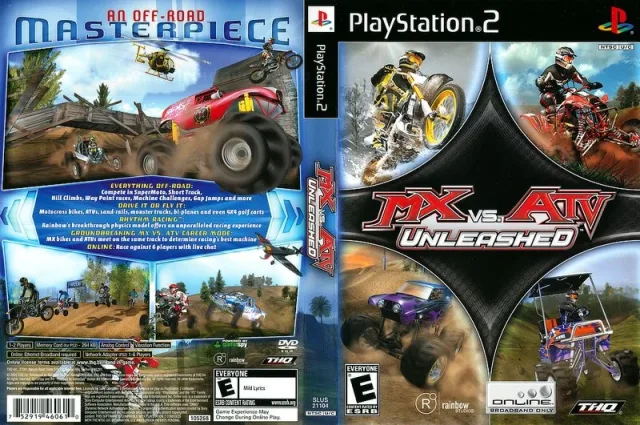
 1.1GB
1.1GB MX vs. ATV Unleashed
Racing 2005

The single most important button here isn't the throttle. It's the left stick pulled back a beat before the lip of a jump, loading the suspension so the quad launches instead of dribbling off the edge. Rainbow Studios had been refining that idea since Motocross Madness on PC, and by this second PlayStation 2 outing the rider and the machine feel like two separate masses arguing with each other over every bump. Get the argument right and you clear a triple. Get it wrong and you pitch forward into the dirt while four other quads bury you in roost.
That physics model is what separates this from the arcade racers it superficially resembles. Quads are heavy, top-heavy things, and the game commits to that: cornering means throwing your weight into the inside of a turn and feathering the brake, not just holding a line. The trick system feeds back into the racing rather than sitting beside it, since air time and stunts fill a boost meter you spend on the straights. It creates a genuine tension. Do you go big off a tabletop for the boost, or play it safe and keep your speed through the rhythm section.
The structure is generous for a 2002 sports title. Supercross-style stadium circuits, wide outdoor nationals, point-to-point enduro runs across snow and desert, plus freestyle courses where the clock and the scoreboard are the only opponents. Progression unlocks machines and riders through a season championship, and there's a mini-game selection that mostly exists to be played by four people on one couch. Split-screen holds up better than most of its era because the tracks are legible even quartered.
What dates it is the presentation. Menus are functional to the point of austerity, the licensed soundtrack is a fossil of nu-metal radio, and the environment textures go soft the moment you look at a distant hillside. None of that touches the handling, which is the reason people still boot it. Sony pushed this one hard as a Network Adaptor pack-in, which put it in a lot of houses that never bought another off-road racer, and it turned out to be a decent ambassador.
Rainbow would eventually take this engine to THQ and build the MX vs. ATV line from it, but there's a leanness to the early Fury games that the sequels traded away for scale. Two dozen hours in, you stop thinking about the analogue stick and start reading the ground ahead of you like a rhythm chart.
1.1GB  1.4GB
1.4GB  1.8GB
1.8GB  0.1GB
0.1GB  2.0GB
2.0GB  0.1GB
0.1GB  0.3GB
0.3GB  1.0GB
1.0GB loading comments…