 2.5GB
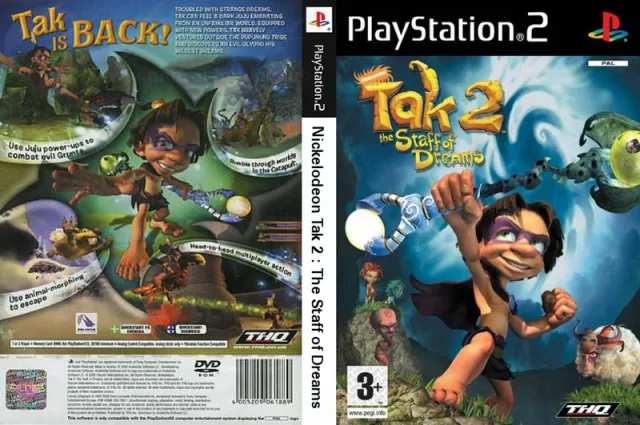
2.5GB Nickelodeon Tak 2 - The Staff of Dreams
Platformer 2004

The smart idea here is that every obstacle is designed for two sets of hands, whether or not a second person is in the room. Tak and his hulking partner Lok move through the Great Juju Challenge as a pair, and a solo player simply taps a button to take control of whichever one the situation needs. A friend can grab the second controller at any point without a trip to the menu. That flexibility was rarer than it should have been on the PS2, where co-op was too often a separate mode with its own stripped-down levels.
Avalanche Software had already made two Tak games for THQ by this point, and the third one quietly abandons the loose adventure structure of the earlier entries for something tighter. The framing is a tournament: rival teams of shamans compete through a gauntlet of trials, which gives the level design an excuse to be a chain of discrete challenge rooms rather than a wandering overworld. Progress is measured in rounds won. It suits the material better than the open-ended jungle romps did, because the puzzles get room to state their terms clearly and then escalate.
The two characters are built as complements rather than clones. Tak is quick, light, and does the acrobatic work; Lok has the muscle for anything that needs breaking or shoving. Layered on top are juju powers collected as the tournament advances, which change how the pair interacts with hazards and each other. The best sequences ask you to set something up as one character and finish it as the other, which is a genuinely different rhythm from ordinary platforming and occasionally trips up the camera, which never quite decides which of the two it should be watching.
What holds it back is the same thing that held back most licensed platformers of the period: a difficulty curve pitched squarely at children and a combat system with maybe three ideas in it. Enemies exist to be swatted between puzzles. The humour is broad Nickelodeon slapstick, funnier than it needed to be but not aimed at adults.
Still, this is the entry in the series where somebody clearly sat down and asked what the two-character premise was actually for. Played with a kid on the second pad, it does the thing good co-op games do — it makes both people talk to each other about a locked door.
2.5GB  2.9GB
2.9GB  0.7GB
0.7GB  1.9GB
1.9GB  1.7GB
1.7GB  0.2GB
0.2GB  0.8GB
0.8GB  1.3GB
1.3GB loading comments…