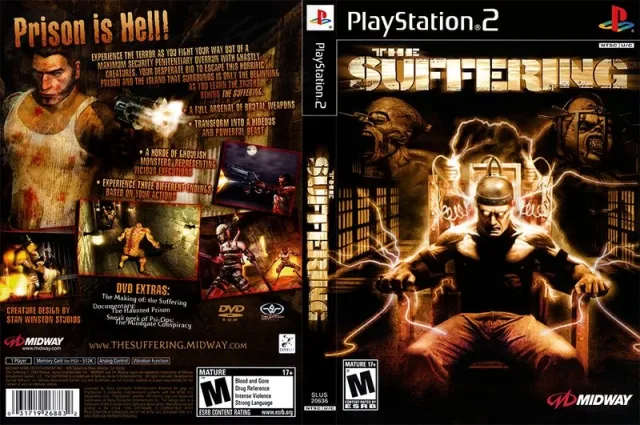
 2.9GB
2.9GB The Suffering
Horror 2004

There is a room in Brookhaven Hospital with a mirror on the wall, and nothing in it will attack you. Stay long enough and the reflected walls begin to darken, then bleed, then the reflection of Heather starts to move a beat out of step with her. That is the whole design philosophy of Konami's Team Silent compressed into one optional space: no threat, no combat prompt, just the slow certainty that you should have left. Players who did not leave found out what happens.
The 2003 sequel picks up the thread of the first game rather than the second, which surprised people at the time. Heather is a teenager in a mall food court when the world stops behaving, and by the time Claudia Wolf and the twitching, unreliable Vincent have finished talking around her, she has been maneuvered back toward a town and a birth she does not remember. The story is more explicit about the cult than the original was, and it loses a little of that game's fog of ambiguity as a result. What it gains is Heather herself, who is sarcastic, frightened and specific in a way survival horror protagonists rarely were, and who reacts to a corpse the way a seventeen-year-old would.
Mechanically it is a refinement rather than a rethink. Tank-adjacent movement, a flashlight and pocket radio that trade concealment for information, melee weapons that swing with real weight and real delay. Combat remains deliberately unsatisfying, and the difficulty sliders let you decouple puzzle difficulty from enemy difficulty, which was a genuinely thoughtful accommodation. The hard puzzle setting is brutal in the old adventure-game way, built around Shakespeare quotations and a poem about hanging.
What still stops people is the presentation. This is one of the best-looking PlayStation 2 games ever released, not because of polygon counts but because the art team understood grime, wet surfaces and human faces. Heather's expressions carry scenes. The subway and the Hilltop Center are made of rust, mildew and industrial noise, and Akira Yamaoka's score moves between grinding metal and Mary Elizabeth McGlynn's vocal tracks without either feeling like a genre concession. The sound design does more damage than the monsters do.
It is shorter and tighter than its predecessors, roughly a single long night's work, and it ends on a note of exhausted grief rather than revelation. Two decades on, the enemies are the least frightening thing in it. The mirror still works.
2.9GB  2.2GB
2.2GB  2.1GB
2.1GB  0.6GB
0.6GB  1.7GB
1.7GB  1.0GB
1.0GB  2.2GB
2.2GB  2.9GB
2.9GB loading comments…