 0.5GB
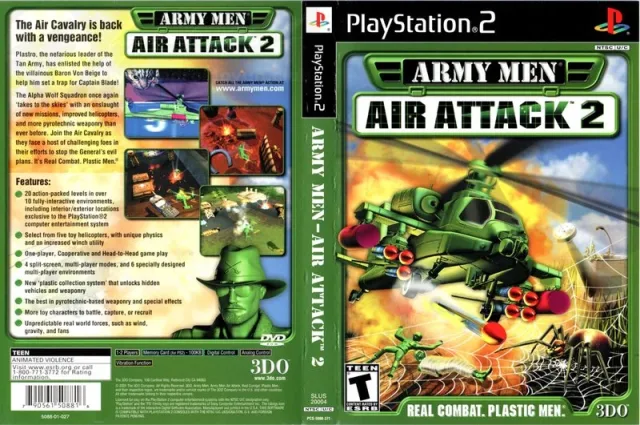
0.5GB Army Men - Air Attack 2
Action 2000

Losing is allowed. That single design decision is what still separates this 2003 Activision crime story from the wave of open-world imitators that followed Rockstar into the sixth generation: blow a mission as LAPD detective Nick Kang and the game does not slap you back to a checkpoint. The story simply takes the worse branch. A suspect escapes, an informant dies, and the narrative carries that damage forward toward one of several endings. For a licensed-scale action game built on a two-year cycle, it was a genuinely brave bit of structure, and it makes a second playthrough feel like a different case file rather than a lap.
Luxoflux, who came from the vehicle combat of Vigilante 8, mapped Los Angeles at street level — Hollywood, Chinatown, Santa Monica, the freeway grid — and the geography is the game's quiet achievement. You can find real intersections. The trade-off is a city that runs thin between missions: traffic is sparse, pedestrians repeat, and the draw distance dissolves into fog when you push a car hard down Wilshire. The world was built for accuracy before it was built for density.
The moment-to-moment play splits three ways, and each is deeper than the era usually bothered with. Gunfights use a free-aim system with dive rolls and slow-motion, letting you shoot weapons out of hands rather than simply emptying a magazine. Hand-to-hand combat is a real fighting engine with unlockable strings, throws and counters, upgraded at dojos between chapters. Driving leans arcade, with tyre-shooting pursuits and a handbrake that treats the whole city as a skidpan. None of the three is best-in-class, but the fact that all three are functional is unusual.
Then there is the cop rating, the system that dates the game most charmingly and most awkwardly. Answer random street crimes, frisk suspects, arrest instead of shoot, and your badge stands up. Run over civilians and shoot the wrong people and you slide toward a dirty-cop ending. It is a morality meter in its earliest, bluntest form, and it never quite reconciles with the pulp tone of a hero who kicks doors in with a pistol in each hand and Christopher Walken barking at him.
What holds up is the confidence. The controls are stiff by modern standards, the sandbox is emptier than its scale promises, and the plot leans hard on Triad-thriller cliche. But a game that lets you fail forward through its own story, in 2003, was reaching for something nobody had quite tried, and Los Angeles has rarely felt this much like a real place you could get lost in.
0.5GB  1.1GB
1.1GB  0.4GB
0.4GB  1.8GB
1.8GB  1.5GB
1.5GB  1.0GB
1.0GB  2.6GB
2.6GB  0.7GB
0.7GB loading comments…