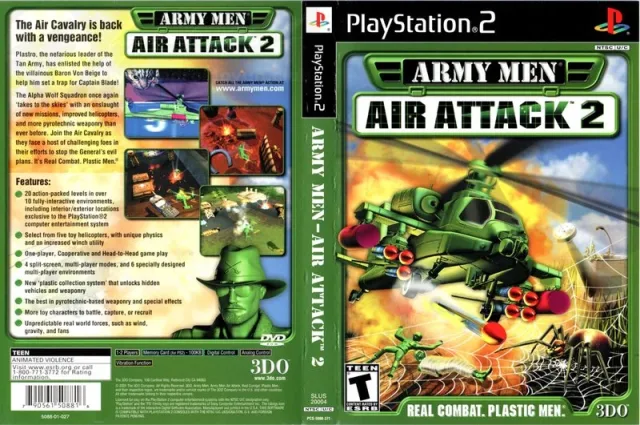
 0.5GB
0.5GB Army Men - Air Attack 2
Action 2000

The targeting system is still the best idea anyone had on the PlayStation 2 for making a one-against-twelve brawl legible. Hold the shoulder button, sweep the right stick across a room, and each enemy in range gets pinned to a face button. Then you stop thinking about geometry and start thinking about order: who dies first, who is about to notice, which of the four you can reach before the spearman turns around. BottleRocket built two games around that mechanic, and in the second one it is asked to carry more weight than it comfortably can.
The fiction runs backwards and sideways from The Mark of Kri, filling in how Rau Utu became the man he was and widening the cast to four playable characters, paired off across the campaign. Tati, the girl who narrated the first game, fights here. So do Griz and Baumusu. The design consequence is that you are almost never alone: one character is under your hands, the other is running on AI, and you can flip between them at will. When it works, it gives you a genuine pincer — one body drawing the guards forward while the other opens throats at the back of the room. When it does not work, your partner walks into a patrol and the mission restarts.
That is the game's central problem, and it is a shame, because everything around it holds up remarkably well. The art direction, all thick ink outlines and Polynesian-flavoured design, has aged better than most of the sixth generation's attempts at realism. Kuzo the hawk still functions as the smartest scouting tool of the era, letting you fly ahead, mark sentries and plan a route before you commit a single footstep. And the violence remains startlingly unglamorous for something drawn like a storybook.
It is also hard in a way that 2005 was already starting to find unfashionable. Enemy counts climb, patrol routes tighten, and the tolerance for a mistimed button flick shrinks until stealth stops being an option and becomes the only option. Reviewers at the time marked it down for exactly this, and for the partner AI, and they were not wrong.
What survives is a game with a genuinely original combat idea, dressed in one of the most distinctive visual styles Sony ever put its name to, undone by a companion who cannot be trusted with a knife. Worth returning to for the parts nobody has copied since.
0.5GB  1.1GB
1.1GB  0.4GB
0.4GB  1.8GB
1.8GB  1.5GB
1.5GB  1.0GB
1.0GB  2.6GB
2.6GB  0.7GB
0.7GB loading comments…