 0.5GB
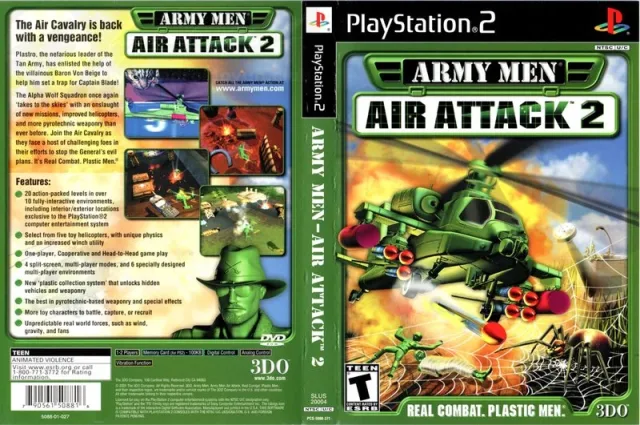
0.5GB Army Men - Air Attack 2
Action 2000

Comic onomatopoeia hangs in the air of a 3D Naples. Capcom's 2002 adaptation of Part 5 painted its cel-shaded world in the ink-and-halftone language of Hirohiko Araki's pages, letting sound effects and impact text float in the environment as physical objects rather than screen overlays. It was one of the earliest attempts to make a game look like a manga instead of like an anime, and years later it still reads as the most confident thing about the project.
The structure is a march through Bucciarati's team crossing Italy, stage by stage, with the playable character switching to match whoever the chapter belongs to. Giorno grows life out of inanimate objects. Mista fires six shots and lets the Sex Pistols redirect them. Narancia's Aerosmith hunts by tracking breath on a radar. Each Stand is essentially its own set of verbs, which means the game keeps resetting your understanding of the controls just as you get comfortable, and that trade-off cuts both ways.
What lifts it above a licensed brawler is how many fights refuse to be brawls. The confrontation with Man in the Mirror requires you to understand mirrors as a separate space. Soft Machine's deflation gimmick is a stealth problem. Several encounters are closer to puzzle boxes than combat, solved by working out the rule Araki wrote rather than by pressure. Hidden objectives reward players who reproduce the exact beat from the manga, a design idea Capcom's later JoJo games borrowed outright.
The rough edges are the sixth generation's usual suspects. The camera fights you in tight corridors, lock-on is unreliable when more than one target moves, and the basic melee underneath all the Stand cleverness is thin and stiff. Boss patterns can feel less like fights than like waiting for a scripted opening. Being Japan-only, it also asks for either reading knowledge or a fan translation, and much of the pleasure is in dialogue and framing.
It is a faithful adaptation before faithfulness became a fighting-game selling point, and it treats the source as a series of specific problems rather than a roster. Play it for the moments where the game trusts you to have read the chapter.
0.5GB  1.1GB
1.1GB  0.4GB
0.4GB  1.8GB
1.8GB  1.5GB
1.5GB  1.0GB
1.0GB  2.6GB
2.6GB  0.7GB
0.7GB loading comments…