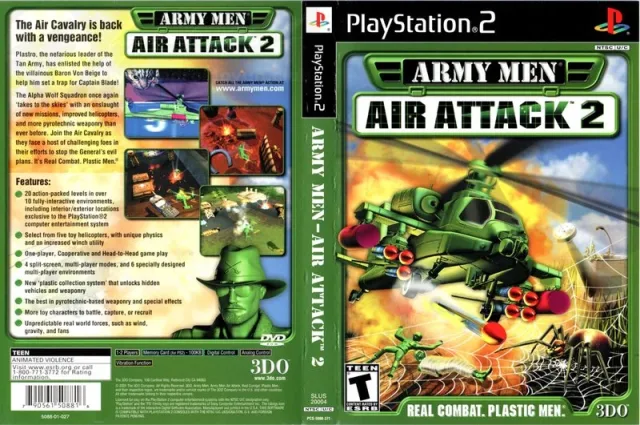
 0.5GB
0.5GB Army Men - Air Attack 2
Action 2000

Grab a parked car, snap it in half lengthwise, and jam a fist into each piece. You now have steel boxing gloves. That single idea does more to explain Radical Entertainment's 2005 Hulk game than any plot summary could, because almost everything in the city is a potential weapon and the game is genuinely interested in what you do with it. A bus becomes a pair of skates. A lamppost becomes a javelin. A helicopter, if you catch it, becomes a handheld rotor blade.
The structure is a light open world across a couple of regions, with story missions handed out by Doc Samson and a running war against General Ross's forces. What holds it together is the smash-point economy. Destruction earns currency, currency buys moves, and the move list is long enough that the Hulk you finish with fights nothing like the one you started with. It is an unusually well-judged progression for a licensed game of the period, because each purchase changes traversal or combat in a way you can feel within seconds rather than nudging a damage number.
Movement is the other thing that still holds. Wall-running up a skyscraper, leaping between rooftops, riding a torn slab of road down a hillside — the traversal is fast and forgiving, and the city is built to be climbed rather than looked at. It is a rough-edged world by modern standards, thin on incidental life and repetitive in its filler objectives, which is where the seams of a 2005 licensed production show most clearly. The camera also struggles when you pin something enormous against a building.
There is a clear line from here to Prototype, which the same studio made four years later; the free-running, the ground-level chaos and the grab-anything combat all originate in this project. Ultimate Destruction arrived when superhero tie-ins were mostly corridor brawlers with a licensed voice cast, and it made an argument that a character's power set should dictate the whole design rather than sit on top of a generic one. Boss fights against the Abomination and the like are decent, but they are not the reason to return.
The reason is smaller and stranger: the moment you realise the game will let you do the thing you just thought of, and that it has already animated it.
0.5GB  1.1GB
1.1GB  0.4GB
0.4GB  1.8GB
1.8GB  1.5GB
1.5GB  1.0GB
1.0GB  2.6GB
2.6GB  0.7GB
0.7GB loading comments…