 0.5GB
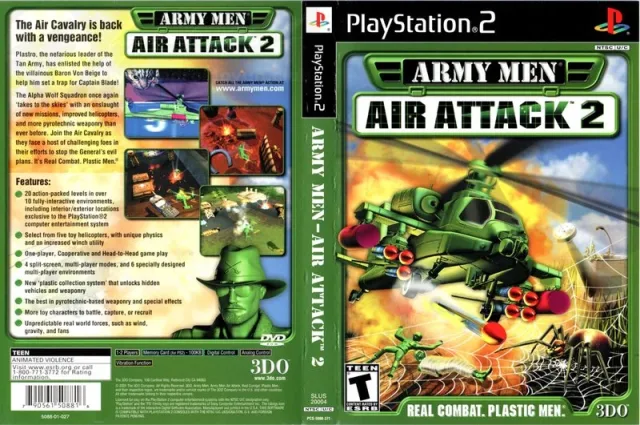
0.5GB Army Men - Air Attack 2
Action 2000

Before you fight anything in this game, you pick a style. Trickster for dashes and wall runs, Swordmaster for extra melee strings, Gunslinger for firearm tricks, Royalguard for parries that store damage and give it back with interest. Each one levels up separately through use, which means the game asks you to commit to a way of moving and then rewards you for going deep instead of broad. That single decision reshaped a series that had been drifting, and it is still the cleanest expression of what character action games are for.
The story runs backward from the first two entries: a younger, louder Dante, a tower called Temen-ni-gru, and a twin brother who wants the family inheritance for entirely different reasons. Vergil is the reason the plot works. He is not a sneering obstacle but a mirror, faster and colder, and the three duels against him are paced across the game like chapter breaks. The cutscene direction under Hideaki Itsuno leans hard into absurdity — pool cues, guitar cases, a man riding a rocket — and gets away with it because the fights underneath are serious.
Western players got a rougher deal than they knew. The North American and European release used a difficulty scaling closer to Japan's hard mode, and the result was a game that punished sloppy positioning from the first boss onward. Cerberus alone sent controllers into walls. It is not unfair, exactly; enemies telegraph, the parry window is honest, healing items exist. But it demands you learn its vocabulary rather than mash through, and in 2005 that was a genuinely unfashionable position to take.
The Special Edition, released the following year, is the version worth knowing. Vergil becomes playable with his own three-weapon setup and a Dark Slayer teleport that plays nothing like Dante, difficulty labels were shuffled to something sane, and Bloody Palace gives the combat system a pure survival arena to be tested in. Turbo mode raises the speed by twenty percent, which sounds like a novelty and turns out to be how the game was meant to feel.
What holds up is the input latency and the readability. Combos land when you press the button, enemies show their intentions, and camera problems that plagued contemporaries are mostly avoided by fixed, generous angles. What has aged is the level structure — a lot of backtracking through the same tower rooms, and puzzle interludes nobody remembers fondly. Neither matters much once you are three styles deep and improvising. Most action games give you a toolkit; this one makes you choose which hands to use.
0.5GB  1.1GB
1.1GB  0.4GB
0.4GB  1.8GB
1.8GB  1.5GB
1.5GB  1.0GB
1.0GB  2.6GB
2.6GB  0.7GB
0.7GB loading comments…