 0.9GB
Rumble Roses
Wrestling 2004
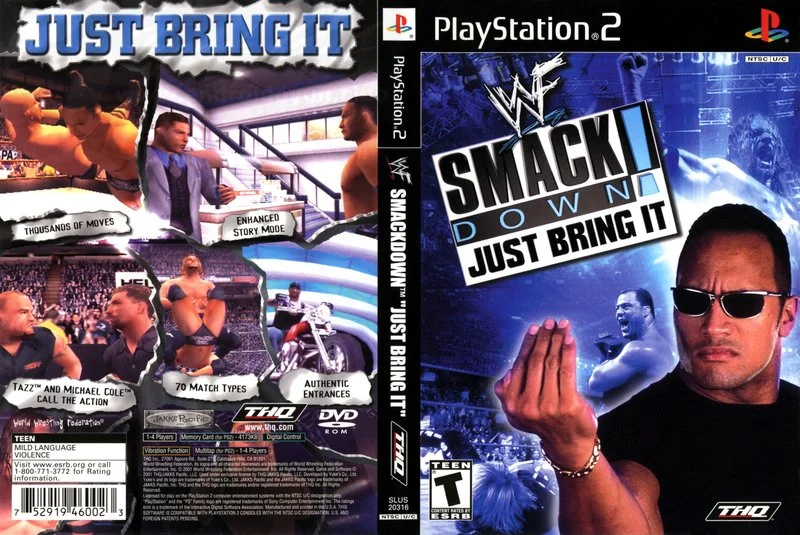
Just Bring It arrived in late 2002, at a moment when the WWF had just split its roster into Raw and SmackDown brands and, in the same year, been forced to change its name to WWE. The game still carries the old initials on the box, a small time capsule of a company mid-identity-crisis. Developer Yuke's was also changing its own approach, and the clearest sign is the way the game handles its ring.
The previous SmackDown games on PS2 had settled into a comfortable formula, and this one reworked the foundations rather than adding another layer. Grapples are built around a strong and weak input split, with moves chosen by direction and by how the opponent is standing or lying. The momentum meter, which lets you hit a signature and then a finisher, keeps its place as the pacing device for each match. It works. A match builds, a comeback feels earned, and the crowd of the era is easy to read in the animations.
The mode list is the traditional Yuke's spread: exhibition matches of various types, a Season mode with storylines, and a create-a-wrestler tool that had a reputation for letting players build the roster the company did not give them. I will not claim more detail than I can stand behind about every match type, but the multiplayer side was a main draw, since wrestling games of this period lived on four people around one television and a grudge.
It has aged unevenly. Character models are rough by modern standards, the load times are noticeable, and the animation transitions can feel stiff when the action piles up outside the ring. The control scheme also rewards memorization over instinct, so the first hour is mostly about learning what you cannot do. After that the pieces settle.
What holds up is the sense that this was a series learning to trust its own mechanics. It is not the best entry in the run, but it is the one where you can watch the wrestling rules being rewritten while the sport itself was rewriting its own name.
0.9GB  3.2GB
 0.6GB
 2.9GB
 2.9GB
 2.5GB
 1.3GB
 2.1GB
loading comments…