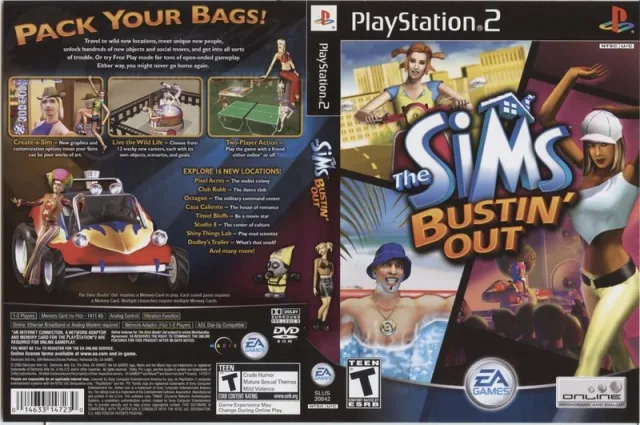
 1.7GB
1.7GB The Sims - Bustin' Out
Simulation 2003

The real game happens in dry dock. Before a single shell is fired you are staring at a hull blueprint, dragging turrets and engines and armor plate into fixed slots, watching the displacement figure creep toward the point where your beautiful gun platform becomes a very expensive reef. Every part has weight. Every weapon needs power and ammunition storage. Add a fourth main battery and you lose speed, or buoyancy, or the space you needed for anti-aircraft mounts, and the ocean is not forgiving of vessels that cannot turn.
That editor is what makes Warship Gunner worth remembering. Micro Cabin and Koei took a fairly straightforward third-person naval shooter and hung it off a construction system with genuine consequences, then let the tech tree wander somewhere strange. It opens as a plausible World War II fiction, cruisers and destroyers exchanging fire across grey water, and gradually starts handing you energy weapons, guided missiles and things no 1943 shipyard ever contemplated. The alternate-history framing earns that drift rather than just excusing it.
Combat itself is deliberate in a way modern action games rarely allow. Ships accelerate slowly and turn worse. You pick a firing solution, lead the target, and wait for shells with visible travel time to arrive, while aircraft harass you from angles your AA coverage may not reach because you skimped on mounts to fit a bigger gun. Missions are objective-driven and often long, and losing one usually means the design was wrong, not that your reflexes were. That is a rare and honest kind of difficulty.
What has aged is the presentation. The water is flat, the environments are largely empty horizon, and the mission structure repeats its shapes more than it should across a long campaign. Menus are dense in the Koei manner, with numbers layered on numbers and little hand-holding about what any of them do to a hull. Players who bounce off spreadsheets will bounce off this.
But the loop it built is durable: fight, salvage technology, return to the yard, redraw the ship, fight again with something that is a little more yours and a little less historical. Two sequels followed and neither improved on the basic pleasure of watching a destroyer you personally over-armed roll gently onto its side. Few games let a bad idea sink you quite so literally.
1.7GB  0.2GB
0.2GB  0.9GB
0.9GB  0.3GB
0.3GB  0.6GB
0.6GB  0.4GB
0.4GB  0.2GB
0.2GB  60MB
60MB loading comments…