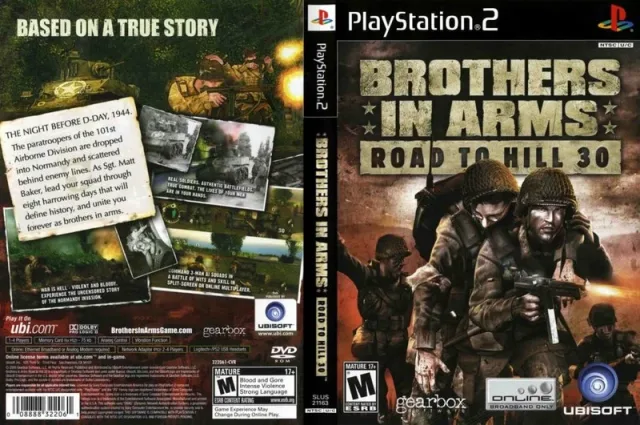
 1.6GB
1.6GB Brothers in Arms - Road to Hill 30
Shooter 2005

The planning map is gone. That single deletion tells you most of what the console line of Rainbow Six became: instead of drawing coloured go-codes across a floor plan and then watching the plan survive contact for about eight seconds, you pick a loadout, walk in with two teammates, and issue orders as you go. Purists lost something real. What replaced it is faster and, in its own narrow way, tenser, because the plan now exists only in your head and has to be revised at the threshold of every room.
Command runs through a context system. Look at a door and you can have your element open it quietly, flash and enter, or frag and enter; look at a corridor and you can hold them, move them up, have them stack on your position. The squad AI is competent rather than clever, and it will occasionally walk a man into a sightline you were counting on. It rarely feels like betrayal, though, because the game is honest about its own arithmetic: two or three rounds kill anyone, you and terrorists alike, and body armour buys you a moment of surprise, not survival.
That lethality is the design. Sprinting is a mistake. Leaning around frames, using the heartbeat sensor to build a rough picture of the floor above, sending the other two through a second entrance while you cover the hostage room — this is the actual loop, and it holds up better than most sixth-generation shooters because it never depended on spectacle. The PS2 build looks plain. Interiors are grey and low-detail, the framerate sags when smoke and gunfire fill a stairwell, and the missions are corridors dressed as buildings.
What it does have is a control scheme that respects a dual analogue pad without pretending it is a mouse. Aim is deliberate, weapon sway is real, and there is no forgiving auto-lock to cover for a bad angle. Anyone raised on later cover shooters will find the first hour punishing and the fifth hour clarifying.
It sits in an odd spot now. It is neither the hardcore tactical sim its PC ancestors were nor the cinematic set-piece shooter the genre turned into a few years later, and the transitional games are usually the ones nobody revisits. Load a hostage rescue, take it slow, and you find a shooter that still punishes impatience harder than almost anything on the machine.
1.6GB  3.5GB
3.5GB  1.9GB
1.9GB  3.0GB
3.0GB  2.4GB
2.4GB  0.7GB
0.7GB  1.7GB
1.7GB  0.3GB
0.3GB loading comments…