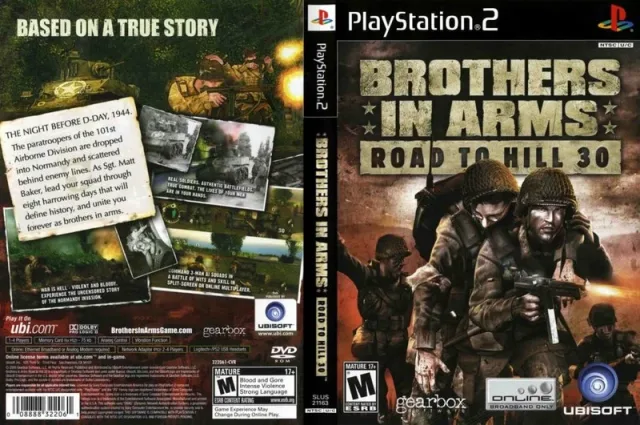
 1.6GB
1.6GB Brothers in Arms - Road to Hill 30
Shooter 2005

Squeeze the trigger on the M82 and the reticle starts climbing. Hold it down and you lose the target entirely. That single decision — that guns should fight you a little — is what separates Guerrilla's first-person shooter from almost everything else on the PlayStation 2, where firearms usually behaved like laser pointers. Aiming down the sights slows you to a crawl, bullets punch through thin cover, and every corner turned feels like it costs something.
The setting earned its reputation honestly. The Helghast, an exiled human colony hardened by a poisoned world into gas-masked soldiers with glowing eye slits, remain one of the better-designed enemy forces of the era, and the ISA's losing defence of Vekta gives the campaign a grim, retreating shape rather than a heroic march. Four playable characters rotate through the chapters: a straight-arrow captain, a sniper, a loudmouth with a heavy weapon, and a half-Helghast intelligence officer whose loyalties are the story's only real question. Levels sometimes branch to suit them, which was ambitious and only intermittently meaningful.
The cost is visible. The game runs badly in places, dropping frames the moment smoke and bodies fill a corridor, and the palette of brown, grey and rust that read as gritty in 2004 now reads mostly as murk. Long sections through trenches and industrial sprawl blur together. It was sold in the press as Sony's answer to Halo, a comparison it could never win, and being measured against that yardstick obscured what it was actually doing well.
What it was doing well was infantry combat with consequences. Helghast squads flank, take cover properly, and lay down enough fire to pin you behind a wall while a second group works around the side. Because your own weapon handling is deliberate rather than snappy, those moments turn into small problems of position and patience instead of reflex tests. The multiplayer, including bot-filled skirmishes for anyone playing alone, ran on the same physical rules and held up better than most console shooter modes of its generation.
Play it now and you can see the DNA of the whole series forming in real time, mud and all. It is heavier, slower and uglier than the sequels, and some of that heaviness was always intentional. The rest was the hardware pushing back.
1.6GB  3.5GB
3.5GB  1.9GB
1.9GB  3.0GB
3.0GB  2.4GB
2.4GB  0.7GB
0.7GB  1.7GB
1.7GB  0.3GB
0.3GB loading comments…