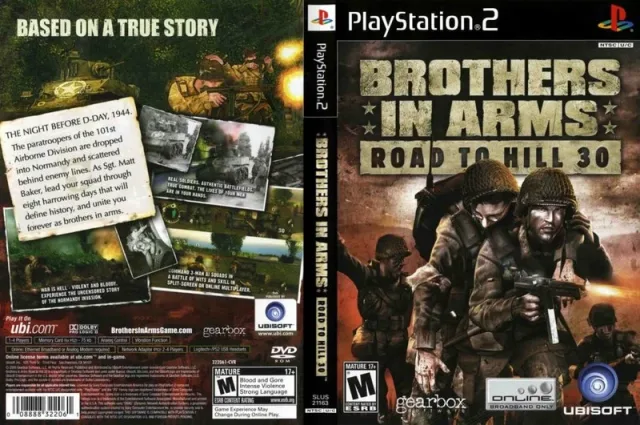
 1.6GB
1.6GB Brothers in Arms - Road to Hill 30
Shooter 2005

The R1 button is the whole argument. Press it and the trail of Options behind your Vic Viper stops obediently mirroring your movement and locks in place, or rotates around you, or fires in a fixed direction while you slip sideways out of danger. Konami had spent nearly two decades treating those satellites as passive damage multipliers. Treasure looked at them and saw a second control scheme hiding inside the first, and the result is a shooter where positioning your firepower matters as much as positioning your ship.
That design came from a studio that had already proven it could think this way. Hiroshi Iuchi came off Ikaruga to direct here, and the fingerprints are obvious in the way stages are built as sequences of solvable spatial problems rather than corridors of oncoming sprites. Bullets are fired in readable patterns you can pick apart. Enemy formations arrive on schedule and reward you for knowing which Option mode answers them. There is a boss in stage 4 that reconstructs the notorious boss rush from Gradius III, and the game is happy to let you know that it knows what it is quoting.
The weapon edit screen offers four loadout types, each shuffling what the power meter gives you, and the differences are real rather than cosmetic; a run built around Spread Bomb plays nothing like one built around lasers. The old cruelty survives too. Die deep into a stage and the checkpoint strips you back to a bare ship against a wall of hardware that assumed you were fully equipped. Some players find that unforgivable in 2004. It is also the reason the good runs feel like something you earned rather than something you were given.
Visually it holds up better than most sixth-generation shooters because it never chases photorealism. The backgrounds are enormous, slow-turning structures and organic tunnels rendered in cold blues and metallic grey, with the camera occasionally swinging around the ship for a set piece and then settling back into flat 2D play. A second player can join for local co-op, which mostly means twice the Options and twice the confusion.
It was the last mainline entry in the series, and it functions as an argument that Gradius still had somewhere to go. Nearly everything in it is a refinement of ideas laid down in 1985, but the refinement is precise enough to change how the game feels in your hands. Learn the Option modes and the difficulty stops looking like an insult and starts looking like a conversation.
1.6GB  3.5GB
3.5GB  1.9GB
1.9GB  3.0GB
3.0GB  2.4GB
2.4GB  0.7GB
0.7GB  1.7GB
1.7GB  0.3GB
0.3GB loading comments…