 1.6GB
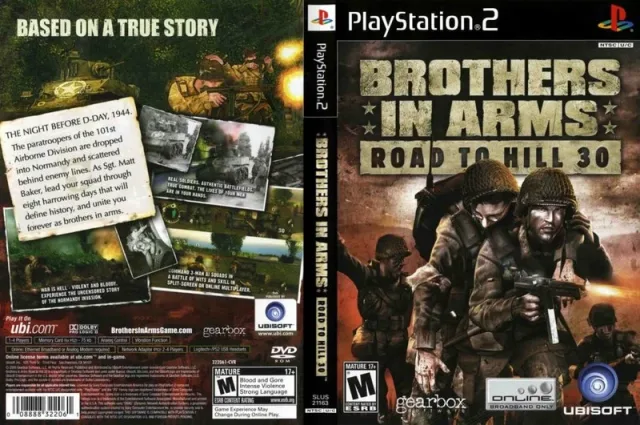
1.6GB Brothers in Arms - Road to Hill 30
Shooter 2005

The moment people remember is the one where a German soldier gets his hands on your rifle. The camera lurches, the screen fills with a face, and you have to wrench the stick to shove the barrel aside before he turns it around. It was the first time the series admitted that a rifleman might have to fight someone within arm's reach, and although it amounts to a quick-time prompt, the panic it produces is real enough to justify itself.
The 2006 campaign follows the closing of the Falaise Gap in the weeks after D-Day, and it splits its attention across American, British, Canadian and Polish soldiers. The Canadians clearing a village and the Polish armoured push are still unusual choices for a war shooter, and they give the game a geography rather than a highlight reel. Treyarch also leaned hard on scripted physical work: bracing a door, wiring a charge, hauling a wounded man out of the road. These sequences slow the shooting down at a time when the series was otherwise picking up speed, and they are the most distinctive thing about it.
The PS2 release is not a downscaled version of the Xbox 360 game. It is a separate build, and it plays like one. Levels are tighter, crowds thinner, draw distance shorter, and the frame rate holds better than the ambition would suggest. What survives intact is the pacing: a corridor of hedgerow and stone wall with your squad shouting position calls, grenade indicators pulsing at your feet, and an enemy count that only stops climbing when you push forward. That last part still feels like a trick rather than a system.
What has aged least well is how little room the design leaves you. The infinite-spawn checkpoint was already a well-worn crutch by the time this shipped, and the game uses it often enough that some encounters become memorisation rather than combat. Vehicle sections vary from decent to filler, and the melee prompts lose their menace once you know the input.
Still, this is the last Call of Duty built entirely around the Second World War infantryman as a body being pushed through terrain, before the series discovered killstreaks and modern optics and never looked back. For a franchise entry usually written off as the annual gap-filler, it holds a stranger, muddier idea of what a war game could be.
1.6GB  3.5GB
3.5GB  1.9GB
1.9GB  3.0GB
3.0GB  2.4GB
2.4GB  0.7GB
0.7GB  1.7GB
1.7GB  0.3GB
0.3GB loading comments…